Gungholmen
The old ironworks at Prästhyttan, on the shore of Lake Väsman, was forced to close when the surrounding forest had been almost entirely clear-felled. The ironworks owner at Ludvika, Anders Wetterdal, eventually obtained permission from the King to establish a new blast furnace. The chosen site consisted of untouched woodland, not far from Skattlösberg in the Finn Forest. There was access to water, inexpensive charcoal, and no need to take other co-owners into account. The furnace was completed in 1829, and Wetterdal appointed his nephew, Johan Petter Ekman, then only in his twenties, as estate manager. At the site, a manager’s residence, a storehouse, a small cottage, a watermill, and a couple of smithies were also built.
Wilhelmina, née Michaelsdotter Claeson, worked for the Wetterdal family as housekeeper. This is how Petter and Wilhelmina met. They married, settled in the manager’s residence, and had five children together. Wilhelmina also had a son, Isidor, from an earlier relationship. During the winter, the family lived in Uppsala so that the children could receive an education.
Unfortunately, no ore was found in the area, and it became necessary to transport it across marshland and lakes from places such as Iviken and Lekomberg, which proved extremely costly. Despite low wages and other attempts to solve the problem, the ironworks was forced to close in 1859. Nevertheless, the couple continued to live there.
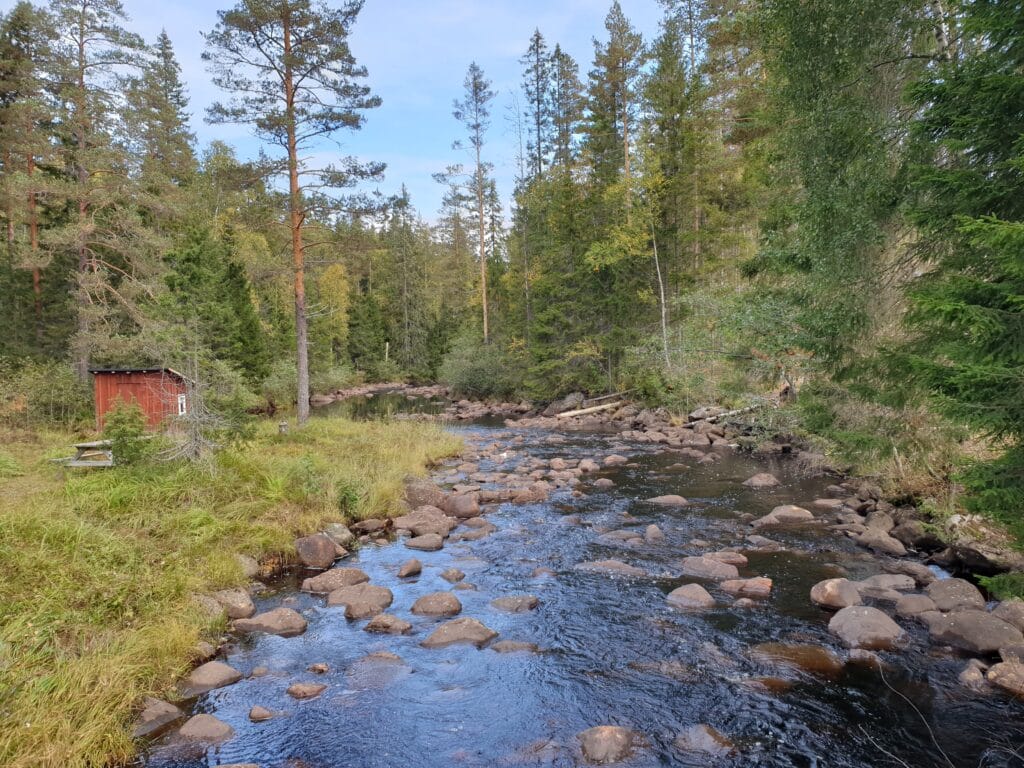
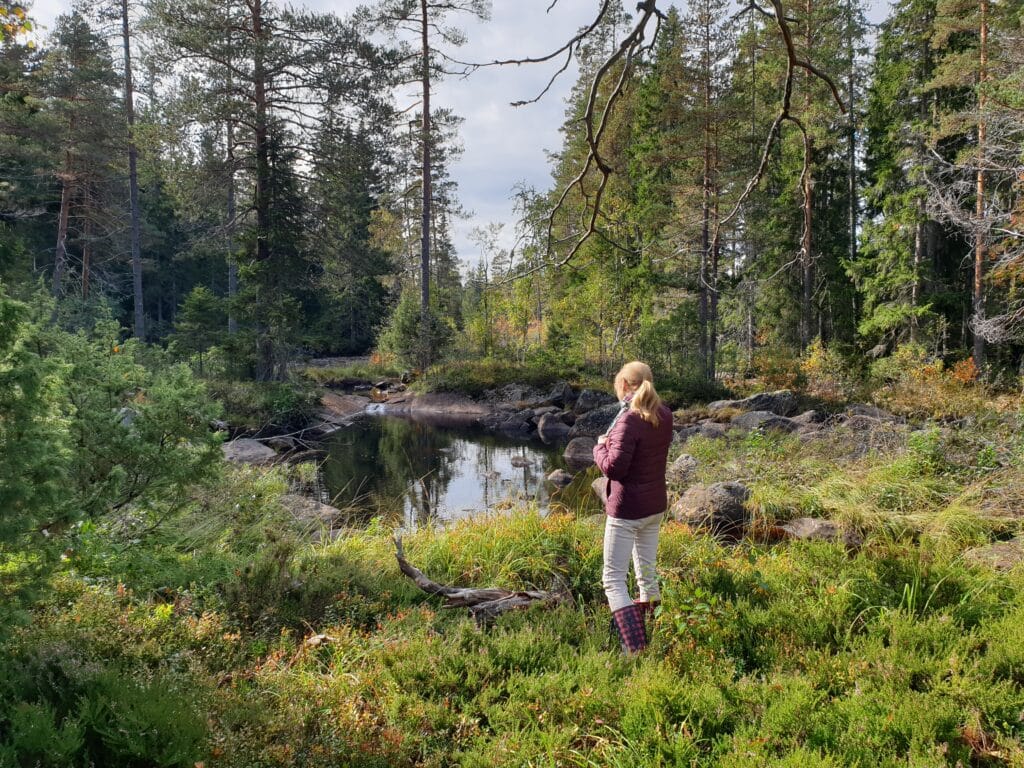
Gungholmen lies a short walk through the forest from the furnace site. From the name, one might assume it to be a floating islet, but in fact the opposite is true. It is a small, solid and stable islet formed by a branching of the Pajso stream, the name deriving from the Finnish verb pajso, meaning “to swell” or “to overflow”. Previously, the stream was known as Parisån “the Paris stream”. The islet itself was originally called Wänneboholmen, but later acquired the name Gungholmen after a large swing (gunga in Swedish) that once hung there.
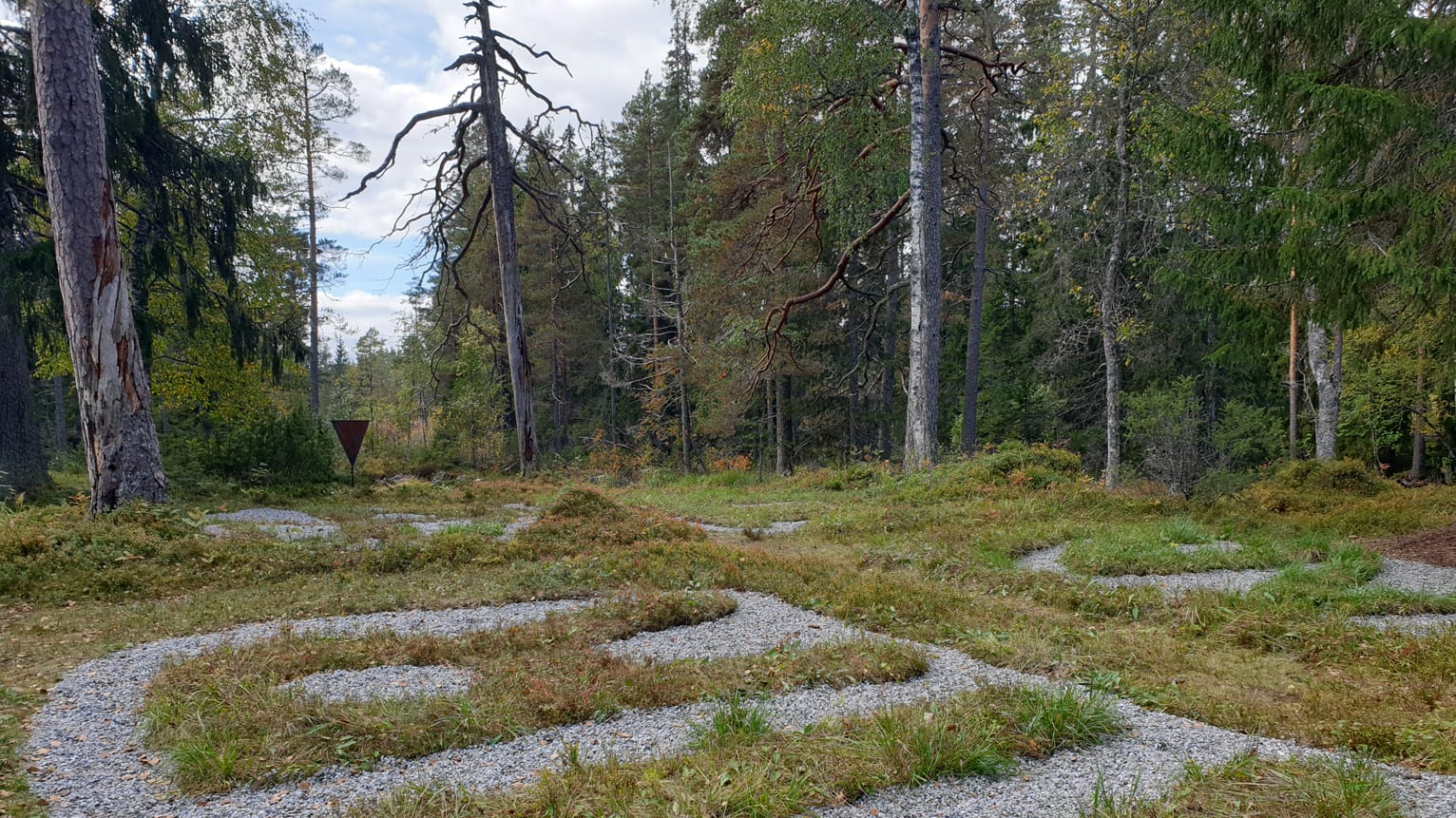
The first thing one notices here is the enormous letters carved into the ground. These are the initials of the ironworks owners and inspectors who owned or managed the works at Nya Prästhyttan, as well as two of their wives and one sister. Originally, the letters were planted with daisies, lily of the valley, cowslips, daffodils, and orange lilies, while the pathways were covered with sand.
At the time, there were two bridges leading to the islet, reportedly with beautifully painted handrails. In a map sketch painted in 1908 by Johan Petter Ekman’s grandson, one can also see that there was apparently a leafy arbour, and that the benches were made of turf.
The summer pavilion is said to have been built by estate manager Petter Ekman, while his wife Wilhelmina created the flower-decorated initials, turf bench, and lilac arbour. The Ekman family, along with the Wetterdal and Roth families and others, used the islet as a small oasis in everyday life, gladly bringing picnic baskets and coffee when guests visited. They picnicked, played cards, sang, swung, and enjoyed nature. Perhaps some even swam or fished for trout.
The People Represented by the Initials
W = Anders Wetterdal (1771–1840)
Owner of Hagge Ironworks, he succeeded in obtaining royal permission to establish a new blast furnace by the Pajso stream. This was an attempt to relocate iron production closer to the charcoal forests. In 1823, he purchased Ludvika Ironworks from the Cedercreutz family. In 1836, he sold two-thirds to Carl Reinhold Roth of Stockholm, father of Carl Roth and Carl Emil Roth, and one-third to Fredrik Langenberg of Västerås.
WE = Charlotta Wilhelmina Ekman (1803–1862), née Michaelsdotter Claeson, wife of Johan Petter Ekman. Daughter of Michael Claeson, a carpenter employed by the Royal Board of Palace Construction. She came to Ludvika Ironworks in 1828 and served as housekeeper to the ironworks owner Wetterdal. In 1829, she gave birth to her son Isidor while unmarried. In 1831, she married Johan Petter Ekman, nephew of Anders Wetterdal. The couple had five children together, and Isidor grew up as an Ekman. It was Wilhelmina who created Gungholmen. She was an enterprising woman, said to have possessed “a delightful temperament and a most advantageous appearance”.
IPE = Johan Petter Ekman (1804–1889)
Husband of Wilhelmina Ekman and nephew of Anders Wetterdal, he was the most prominent figure in the history of Nya Prästhyttan. A native of Värmland, Ekman took up the inspector’s post in 1830 and managed the works for no fewer than fifty years. When manager Dahlström took over in 1883, the name was changed to Wännebo as a tribute to the much-loved Ekman. Industrial operations had by then ceased some 15–25 years earlier.
AIR = Augusta Jacobina Roth (1806–1882), née Setterwall, wife of Carl Reinhold Roth and mother of Jenny, Carl, and Emil Roth.
CR = Carl Edward Roth (1828–1898)
Born in Stockholm and educated in Uppsala, he later worked in the Government Offices. Not yet thirty years old, he was asked by his father to take over the management of Ludvika Ironworks, which also included Sunnansjö Ironworks and Nya Prästhyttan. He trained in mining and metallurgy at Larsbo Ironworks and studied for two years at the Mining School in Falun. He married Laura Mathilda Moberg, born in 1834 at Larsbo Ironworks, daughter of the estate manager there. They had sons Carl, Erik, and Emil, as well as daughters Jenny and Maria. He remained owner of Ludvika Ironworks for nearly forty years, partly running it alongside his brothers Carl Emil and Carl Ehrenfried.
ER = Carl Emil Roth (1830–1885)
Brother of Carl Edward and Carl Ehrenfried Roth, and co-owner of Ludvika Ironworks. Based in Stockholm, he managed the works’ sales and finances.
IL = Elisabeth Jenny Theresia Lewin, née Roth (1833–1882) Jenny Lewin was the daughter of Carl Reinhold Roth and Augusta Jacobina Roth, née Setterwall. In the 1850s, she married the physician Knut Fabian Lewin of Säter.
“IL” had previously been interpreted as Isidor Langenberg, “who is said to have had financial interests in the ironworks”. However, following the discovery of a copy of the original sketch painted by Johan Petter Ekman’s grandson, it became clear that the initials refer to Jenny Lewin. In the other names beginning with “J”, such as Jacobina and Johan, the letter “J” had also been written as “I”.
Gungholmen was designated a protected natural monument in 1929 following an application by the Dalarna Heritage Association through Karl-Erik Forslund. At the time, the island contained pine trees up to five hundred years old. Many have since disappeared, but a few still remain.